

CLAUDE.md files, your skills, your MCP servers: all of it keeps working. Fermata adds the factory around it.
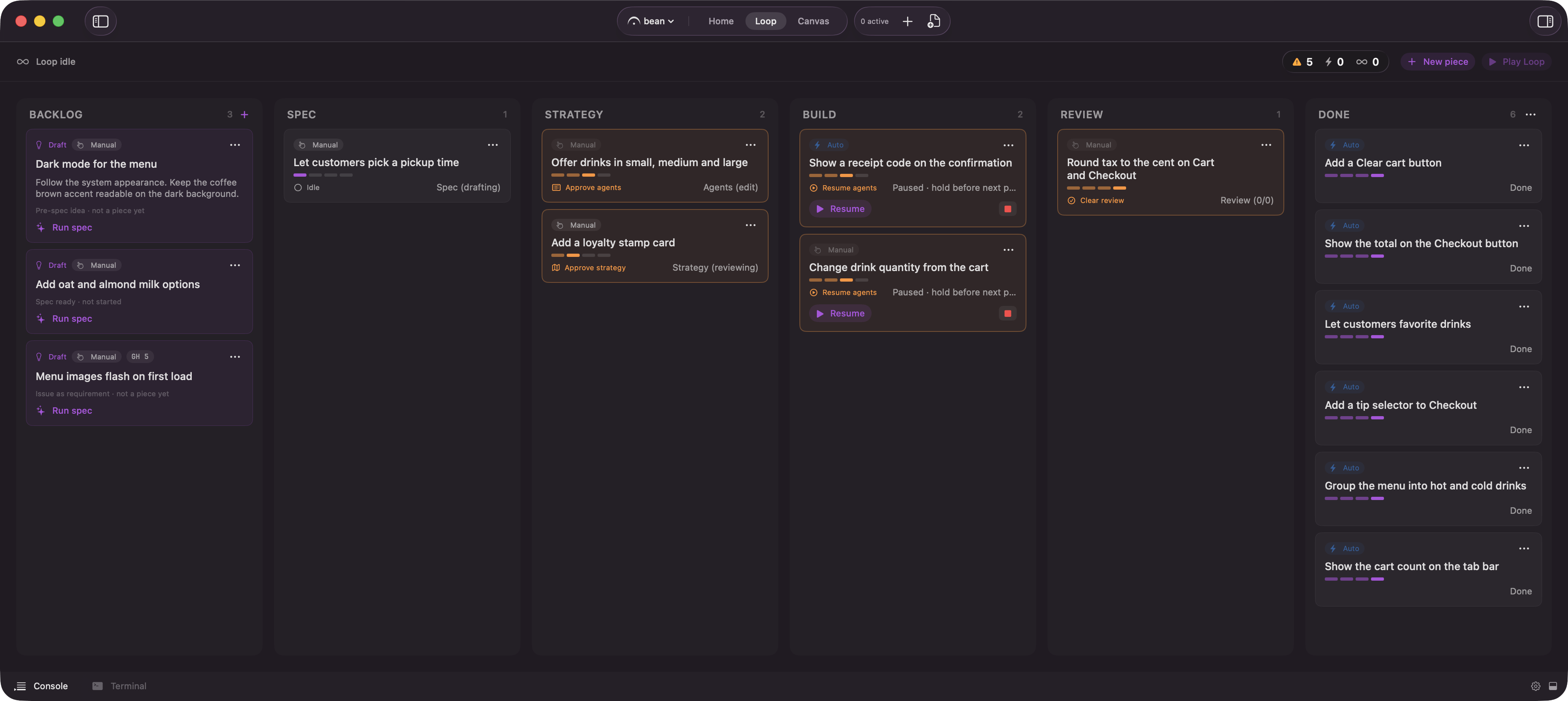
The Loop board: Backlog, Spec, Strategy, Build, Review, Done, with the cards that need you on top
The piece is the unit of work
A piece is one spec and one pull request. Bigger than a single session, smaller than a project. It owns its documents, its git worktree, and its branch, so nothing an agent writes touches your checkout until you merge. Every piece walks the same four phases, shown as a rail in its workspace:- Spec. A guided interview reads the relevant parts of your codebase and drafts the spec with you. See the interview and the spec.
- Strategy. Fermata proposes a plan you can annotate, edit, or regenerate. See strategy.
- Agents. A team of coding agents does the work inside the piece’s own worktree, one commit per agent. See agents.
- Review. You read the diff, then it opens the pull request through
gh. See review and the pull request.
The Loop board runs many of them
The Loop board is the factory board: six columns from Backlog to Done, one card per piece. Press Play Loop and the hands-off pieces advance on their own; press Pause Loop and running agents finish their current turn before everything settles. The Backlog holds drafts: ideas filed as cards that wait until you release them. A draft on the Loop lane is the exception; it starts on its own while the Loop is playing. See the board. One word, three things. Loop is the engine that runs pieces hands-off, the Loop board is its view, and the Loop lane is what enrolls a piece in it.You decide the leash
How much happens without you is yours to set, per piece. The leash is the lane picker, with three settings named Manual, Auto, and Loop, and three gates that add stops back into a lane that would otherwise run on its own. Two review passes and one ending switch sit beside them. A second, separate setting governs what agents may do without asking: the permission profile for tool calls. The two are easy to confuse, so one page holds both: the two layers. Whatever you set, one thing does not change. Fermata opens the pull request and stops there.The Canvas is where you watch
The Canvas is the spatial view of running agents. Every session is a node, colored by what it is doing, and a piece appears as a card you can expand to see its agents inside. Open any node to read its work. It is also where you start a one-off standalone session when a piece would be more ceremony than the job deserves. See the Canvas and standalone sessions.From your phone
A paired iPhone or Android phone creates pieces, runs the spec interview, approves gates and tool calls, chats with sessions, and hands you the button to merge the pull request. It shows no diffs and has no board. It is a limited beta with a waitlist. See the phone companion.Local and yours
The repository, the prompts, and the analytics stay on your Mac. There is no cloud control plane and no per-seat platform in the middle. The local analytics are read straight from your own Claude transcripts on disk, so they are true whichever model or plan you run. See privacy and data. Fermata is free. There is no license, no seat, and no subscription. Running agents uses your own Claude, and Anthropic meters that usage; Fermata does not include or cover it.Start here
Your first ten minutes: one standalone session on the Safe profile, then one piece on the Manual lane. That order shows you what an agent does with your repo before you hand it a whole feature.Install and first run
Homebrew or a signed DMG, plus the two command-line tools Fermata expects. Under two minutes.
Your first piece
Walk one feature from a short interview to an opened pull request.
Coming from the CLI
What stays the same when Fermata runs Claude Code, and what it adds.