

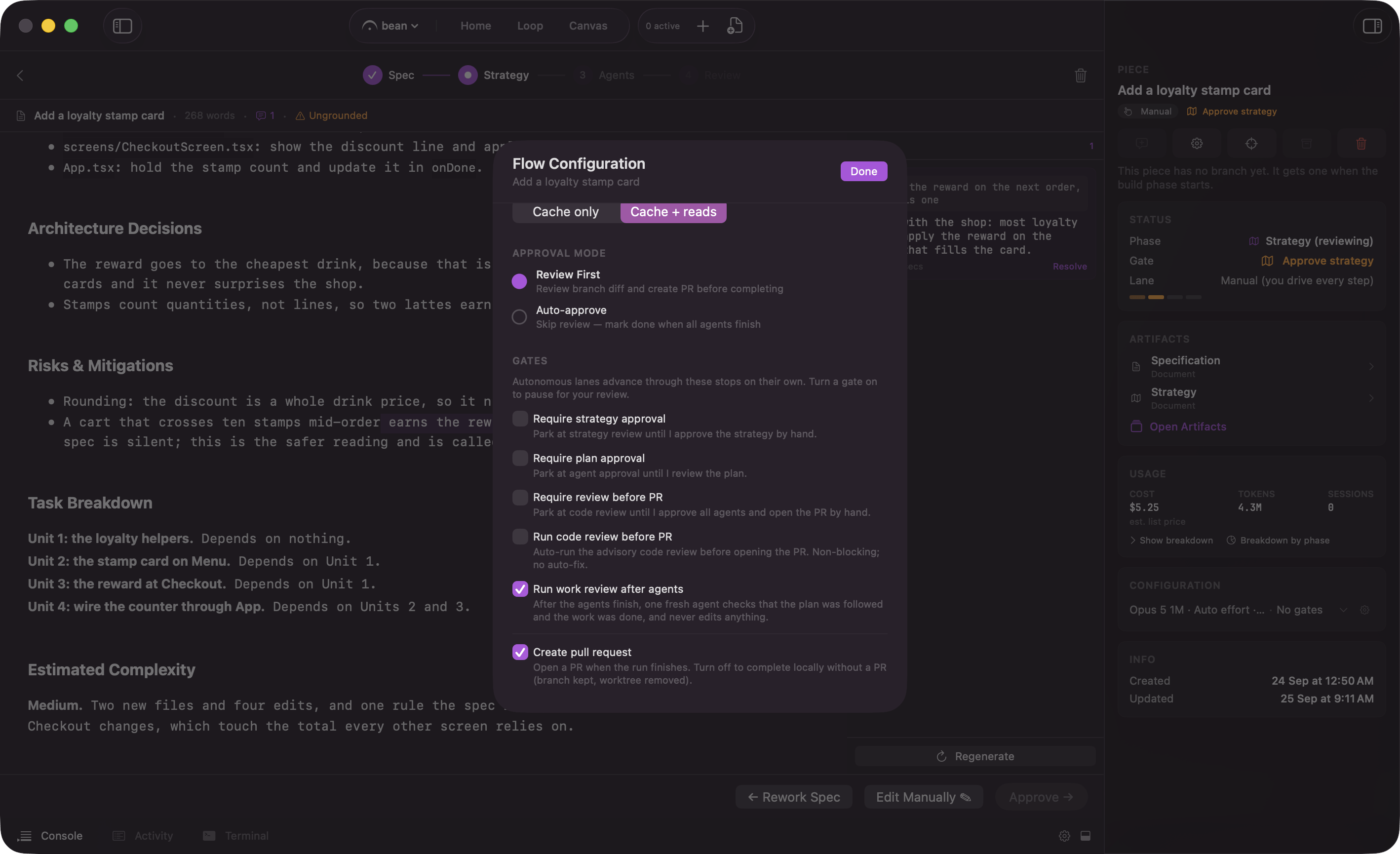
Per piece: the three gates, the two passes, and the ending switch
The defaults, side by side
The two defaults point in opposite directions, on purpose.
A piece looks permissive at the tool level and conservative at the phase level. A standalone session is the reverse.
The reason is containment. A piece’s agents work in the piece’s own git worktree and branch, never in your checkout, so a bad edit there is bounded by a branch nobody has merged. You can read it, rewrite it, or throw the branch away. A standalone session may be pointed at your working copy, where a bad edit is not bounded by anything, so it asks first.
Neither default lets an agent publish. See permission profiles and approvals for the rule and where it sits. Fermata opens the pull request itself at Review, and you merge.
What happens if you do nothing
No default fires when you look away, and only one thing has a clock on it.- A parked piece waits. It stops at the gate, keeps its worktree and its branch, and shows up in “Needs You” on Home, in the counter on the Loop board, in the “Gate” row of its inspector, and in the menu bar. It stays there until you answer.
- A pending tool approval blocks that session. The agent is mid-turn and stays mid-turn. Other sessions and other pieces are unaffected. This is the one wait with a limit: the Claude Code hook that holds the call open is registered for 24 hours, and after that the CLI stops waiting for the answer and carries on as if the hook did not exist.
- An MCP confirmation waits too. When an outside agent asks for one of the actions that start, stop, or finish work, the confirmation card parks until you answer it. Fermata puts no timeout on it; only the calling client’s own clock can give up.