

Providers are detected from your environment
Fermata has no provider-credential form. It detects your provider from your environment and routes accordingly, the same way the Claude Code CLI does, checked in this order:
Configure the provider’s own credentials the way that provider expects (AWS, Google Cloud, or the gateway’s own auth), and Fermata inherits them.
The “Model Provider” card in Settings → Sessions shows what was detected and, for anything but the direct API, a Force Anthropic API checkbox that ignores the detection and sends model IDs to the direct API unchanged; when a gateway is detected it also carries a Re-read button to pick up a change.
Fermata runs on your own Claude setup and your own billing. Nothing here is free or included; the provider you point it at is the one that bills you.
Three places you pick a model
The Settings model picker chooses the app’s default. Three chips override it for a single interview or a single run:
A fourth chip, Explore model, sits beside the interview composer’s model chip rather than replacing it: it picks the model the spec’s Explore subagents run on, seeded from a remembered fast, economical default rather than from the interview’s own model. See interview and spec for where it sits and what picking it changes.
Every one of these chips lists the same catalog, filtered to whatever the bound project’s provider actually offers, so a pick can never name a model that project cannot run.
Pick a model per run
The picker is organized by what the model is for, and it reflects the current catalog, which can update without an app release.- “Balanced” is the default tier: fast, and capable enough for the bulk of coding work.
- “Most capable” is for jobs that are genuinely hard, like tricky refactors and architecture calls.
- “Fast & cheap” is there for the lightest work.
- Options whose name ends in “1M” carry the extended 1M-token context window. Pick one when a run genuinely needs that much context.
A gateway’s own picker
Companies commonly put Claude Code behind an LLM gateway (LiteLLM and similar). They pin the gateway in<CLAUDE_CONFIG_DIR or ~/.claude>/settings.json with an env block, and curate which models the CLI’s own /model menu offers under modelPicker.options. Fermata reads the same file and mirrors the same list, so every chip on this page shows models the gateway can actually serve instead of the Anthropic catalog IDs it may not recognize.
modelPicker.options: a curated list, each entry amodelID, a menulabel, and an optionaldescriptionshown as a tooltip (price, latency, context).ANTHROPIC_DEFAULT_FABLE_MODEL,_OPUS_MODEL,_SONNET_MODEL, and_HAIKU_MODEL(each with an optional_NAMEvariant for the display label): family redirects. Fermata shows each as an entry in the tier its family stands in for, so a Fable or Opus alias sorts under “Most capable”, a Sonnet alias under “Balanced”, and a Haiku alias under “Fast & cheap”.
env block carries (an ANTHROPIC_AUTH_TOKEN, for instance), is skipped at parse time and never copied into app state. A gateway whose ANTHROPIC_BASE_URL resolves to api.anthropic.com is treated as the direct API, not a gateway: only a different host flips the picker over.
A gateway with an ANTHROPIC_BASE_URL but no modelPicker.options and no aliases still works: Fermata falls back to showing the Anthropic catalog and passes its IDs through to the gateway unchanged.
The “Model Provider” card in Settings → Sessions shows the mirror as it stands: the settings file’s path, how many curated models and aliases it found, when it last read the file, and a Re-read button to pick up an edit without relaunching. A settings file that exists but fails to parse as JSON shows its own error inline: “Could not read settings.json: the file is not valid JSON.” Every count and path on this card is global; a project with its own Claude config directory reads its own picker instead, so its chips can disagree with this card without either being wrong.
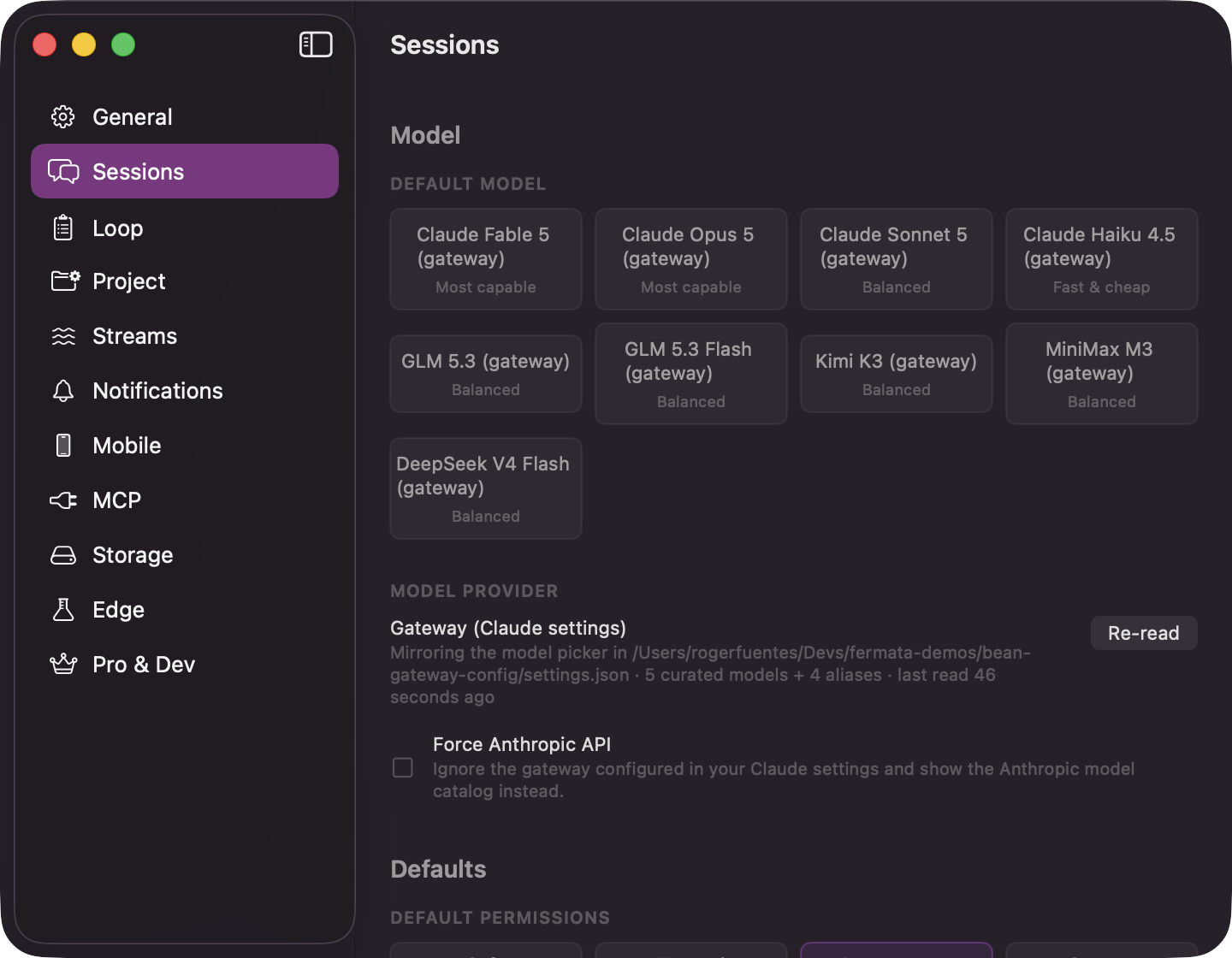
Settings → Sessions with a gateway: the Model Provider card mirroring settings.json, with counts, last read and Re-read
Force Anthropic API
When a gateway or a cloud provider is detected, the provider card offers Force Anthropic API: a checkbox that ignores the detection and sends model IDs straight to Anthropic’s own API. Its caption for a detected gateway reads exactly: “Ignore the gateway configured in your Claude settings and show the Anthropic model catalog instead.” Turning it on switches every chip back to the built-in catalog immediately; turning it off restores the mirrored list.Effort
Effort tunes how much reasoning the model spends per turn. The options are Auto, Low, Medium, High, Extra High, and Max. Auto lets the model decide; the rest pin it. You set effort at three levels, most specific wins:- App default. Settings → Loop → Default Effort (and Project Settings for a per-project override).
- Per piece. In the flow configuration, as Reasoning effort for all stages.
- Per stage. Override a single phase when it needs more thinking than the rest.