

origin/<base> fresh and pins what it reads as the piece’s baseCommit, so the agent graph and the piece’s own worktree fork from that same commit rather than whatever origin has moved to by the time agents start. The Activity feed records it, for example “Strategy reads main at 4f2a91c (fetched from origin)”. If the fetch fails, it falls back to the local branch tip, and the Activity line says so.
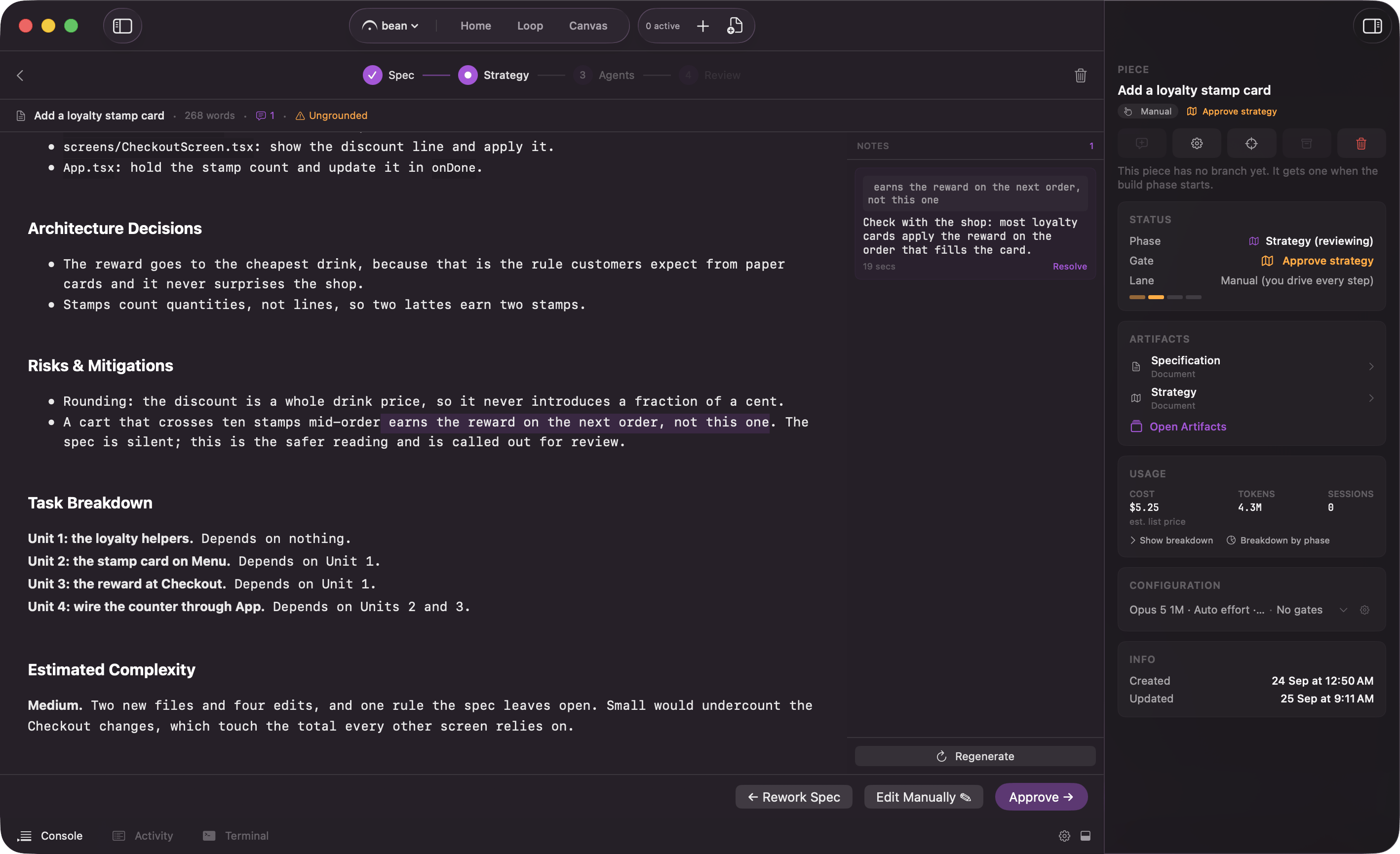
A generated strategy: Estimated Complexity, notes in the margin, and the approve control
Grounded or Ungrounded
A chip in the header says which of two things you are reading.
The difference is whether the analysis step landed before the plan was written. Grounded plans know what already exists in your repo; ungrounded plans are working from the spec text. Neither blocks anything, but an “Ungrounded” chip is a good reason to leave a note and Regenerate, which captures the analysis again before rewriting, or at least to read the plan harder before approving it. See the interview and the spec for where the analysis comes from.
Estimated Complexity
The strategy template asks for an## Estimated Complexity section, resolving to one of four sizes: Trivial, Small, Medium, or Large. It is a sizing hint, not a gate: Approve stays enabled with or without it, and a strategy that states no readable size falls back to Medium.
What it feeds is the default split budget for the Agents phase, the ceiling on how many agents that phase spreads the work across before you override it. See limits for the size-to-cap table and how to override it.
Notes in the margin
You are not stuck with what the model produced. Select any run of text in the document and leave a note on it. Notes stack up in the “NOTES” panel down the right margin, each showing the snippet it is anchored to, and the header counts how many are still open.Leave a note on the plan, then regenerate the strategy with it
Regenerate
Regenerate, at the bottom of the “NOTES” panel, rewrites the strategy with your open notes folded in. It stays inactive until at least one note exists, because regenerating with no feedback just rolls the dice again. Two or three passes until the plan reads right is normal.Edit Manually
Edit Manually opens the document for direct editing, and flips to Done Editing while you are in it. Use it for the small corrections that are faster to type than to explain: a wrong filename, a missing step, an ordering you want swapped. It is disabled while generation is in flight.Approve
Approve closes the phase and moves the piece to Agents, decomposing the plan into the agent graph on the way. It is disabled while either of two things is true:- Any note is unresolved. The tooltip counts them.
- The document is missing a required section. The tooltip names which ones.
Rework Spec
Rework Spec is the one backward edge out of this phase. Confirming it discards the strategy and its notes, and reopens the spec for editing; marking the spec ready again generates a fresh strategy. It is offered only while stepping back is genuinely free: before any agent has ever started, and never while generation or decomposition is in flight. Past that point the piece is running, and the way back is a Review round instead. The confirmation names exactly what is lost, and offers two ways to confirm it, not one. Rework and hold parks the piece at the reopened spec until you approve it yourself. Rework and keep running reopens the spec too, but lets an autonomous run carry the piece forward from it on its own instead of waiting for you. Both buttons discard the same strategy; the choice is only about what happens next, and neither can be undone.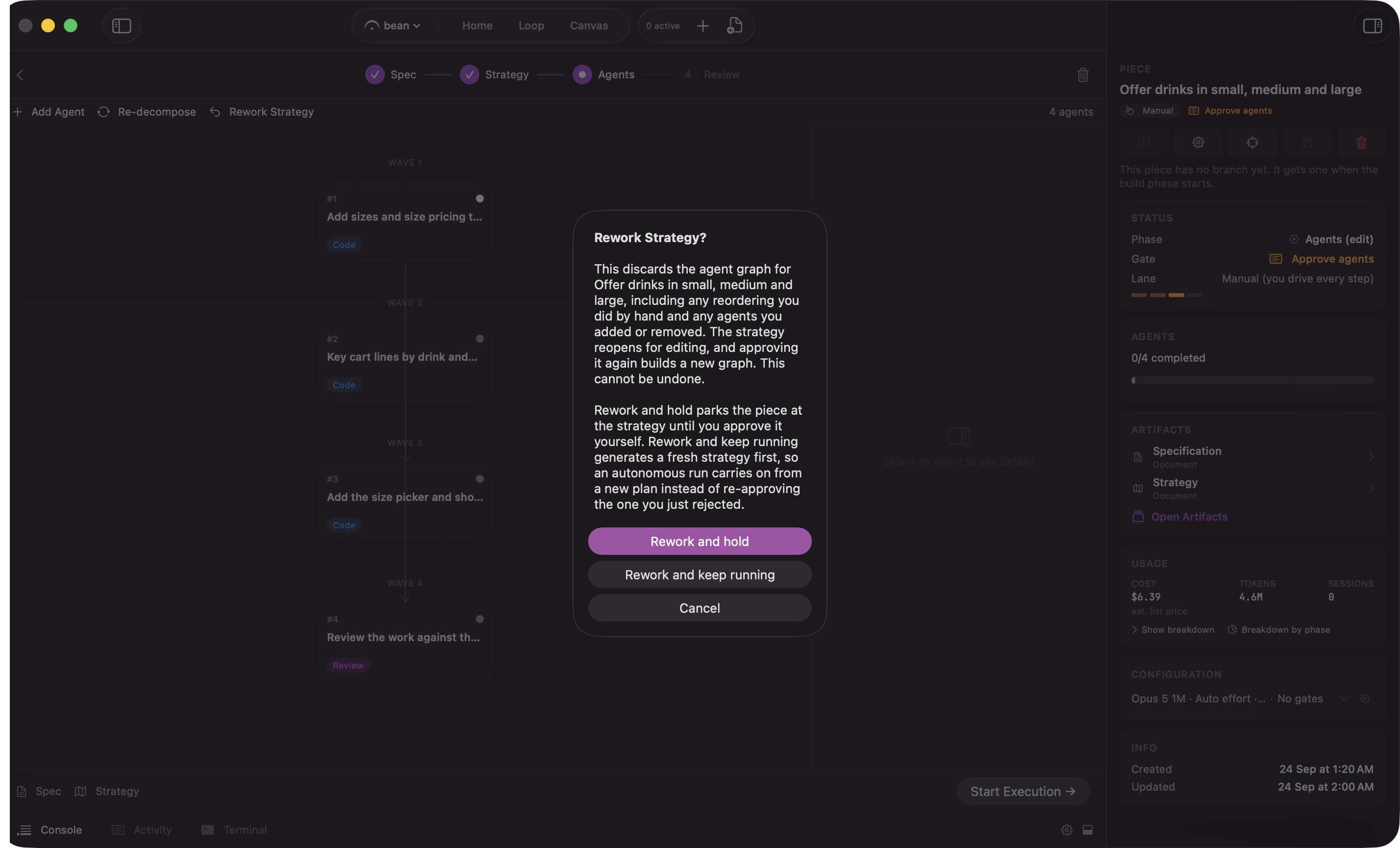
Rework: hold the piece for you, or let the run carry on from the new plan